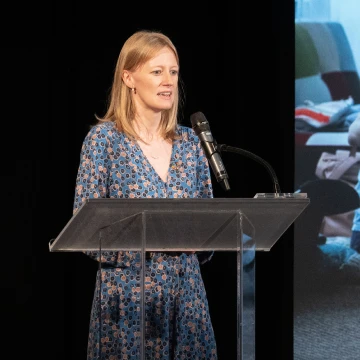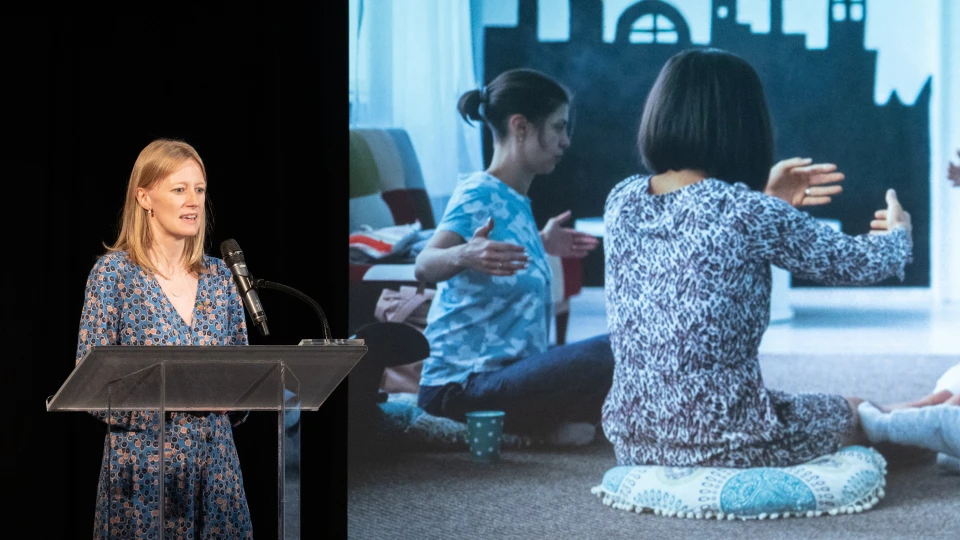
Daisy Fancourt, chair of the Jameel Arts & Health Lab steering committee, named UNESCO Chair in Arts and Global Health
LONDON, ENGLAND – 17 MARCH 2026
Community Jameel is delighted to announce that Professor Daisy Fancourt, chair of the steering committee of the Jameel Arts & Health Lab, has been appointed as the new UNESCO Chair in Arts and Global Health.
A professor of psychobiology and epidemiology at University College London (UCL), Professor Fancourt is a global expert on the health impact of arts engagement and leads the Social Biobehavioural Research Group at UCL.
Awarded by the United Nations Educational, Scientific and Cultural Organisation (UNESCO), the new UNESCO Chair in Arts and Global Health establishes a partnership between Professor Fancourt's team and UNESCO in a common area of priority.
Professor Fancourt's UNESCO Chair will focus on quantifying the long-term health and wellbeing benefits of arts and cultural engagement in communities, as well as in formal education and informal learning across the life-course, to strengthen the case for their prioritisation.
This includes understanding global patterns of arts engagement and barriers to access through analyses of multi-country surveys, to provide a clear picture of where access to the arts is inadequate, unequal, or unjust.
Bridging UNESCO and WHO for global arts and health
Co-founded in 2023 by the World Health Organisation (WHO) Regional Office for Europe, the Steinhardt School at New York University, Community Jameel and CULTURUNNERS, the Jameel Arts & Health Lab has a mission to measurably improve health and wellbeing through the arts, and is the first major initiative of its kind to be supported by the WHO. Professor Fancourt has chaired the Lab's steering committee since its establishment.
In addition, Professor Fancourt's group at UCL is a WHO Collaborating Centre on Arts and Health, making her only the second holder globally of both UNESCO Chair and WHO Collaborating Centre Director status.
Working closely with UNESCO and the WHO, Professor Fancourt will work on trials of arts-on-prescription and broader social prescribing initiatives globally to assess whether such schemes can increase equity of arts and cultural engagement and improve health outcomes.
Major new policy reports, technical briefings and resolutions will also be produced jointly with UNESCO and the WHO in order to build global collaboration and research capacity on arts and health.
Professor Daisy Fancourt, chair of the Jameel Arts & Health Lab steering committee, said: "I'm delighted to be named as a UNESCO Chair. Through our work with WHO over the past nine years we've achieved major policy progress integrating a consideration of arts into health policies in many countries internationally. The new UNESCO designation gives us an exciting remit to consider opportunities within cultural policies and international practice too."
Cecilia Barbieri, chief of section on global citizenship and peace education, UNESCO Education Sector, and co-lead of the implementation of the UNESCO Framework for Culture and Arts Education, said: "The establishment of this UNESCO Chair at University College London marks a significant milestone for advancing the integration of culture and education as a catalyst for health and well-being.
"This Chair operationalises the UNESCO Framework for Culture and Arts Education, bringing together a global programme of work to influence policy and practice. Building on this promising collaboration between UNESCO and UCL, it will strengthen evidence-based integration of culture and arts across health and education policies worldwide."
Professor Anne Anderson, chair, United Kingdom of Great Britain and Northern Ireland (UK) national commission for UNESCO, said: "The UK National Commission for UNESCO is delighted to congratulate Professor Daisy Fancourt on becoming a UNESCO Chair. The important work she does on demonstrating the health and wellbeing benefits of engaging with art, culture and heritage will be an enormous benefit to our UK UNESCO Chairs network."
George Richards, director of Community Jameel, said: "Professor Daisy Fancourt’s appointment as UNESCO Chair is a milestone for the field of arts and health and recognises her pioneering work at UCL and beyond. As director of a WHO Collaborating Centre and chair of the Jameel Arts & Health Lab steering committee, Daisy is uniquely placed to harness the opportunity of her new appointment to advance the global arts and health movement and expand our understanding of how the arts improve health and wellbeing."
Building the future of arts and health research
The UNESCO Chair programme of work will be delivered by Professor Fancourt and a team of colleagues within UCL, working in close collaboration with international partners.
Alongside the WHO and the Jameel Arts and Health Lab, partners include Global Cultural Districts Network, Art and Global Health Center Africa, Global Arts in Medicine Fellowship and academics across the UK, Japan, Chile and Malawi.
The UNESCO Chair role builds on the recent announcement of GRACE-Epi, a major new 7-year programme of work on arts and health funded through a GBP 3.5M Wellcome Discovery Award. Led by Professor Fancourt, this programme is bringing together a consortium of global researchers to unite expertise from arts, humanities, social science, epidemiology, data science and molecular biology and radically advance epidemiological research on arts and cultural engagement.
Discover more